
Fear, Faith and the Sacred Way
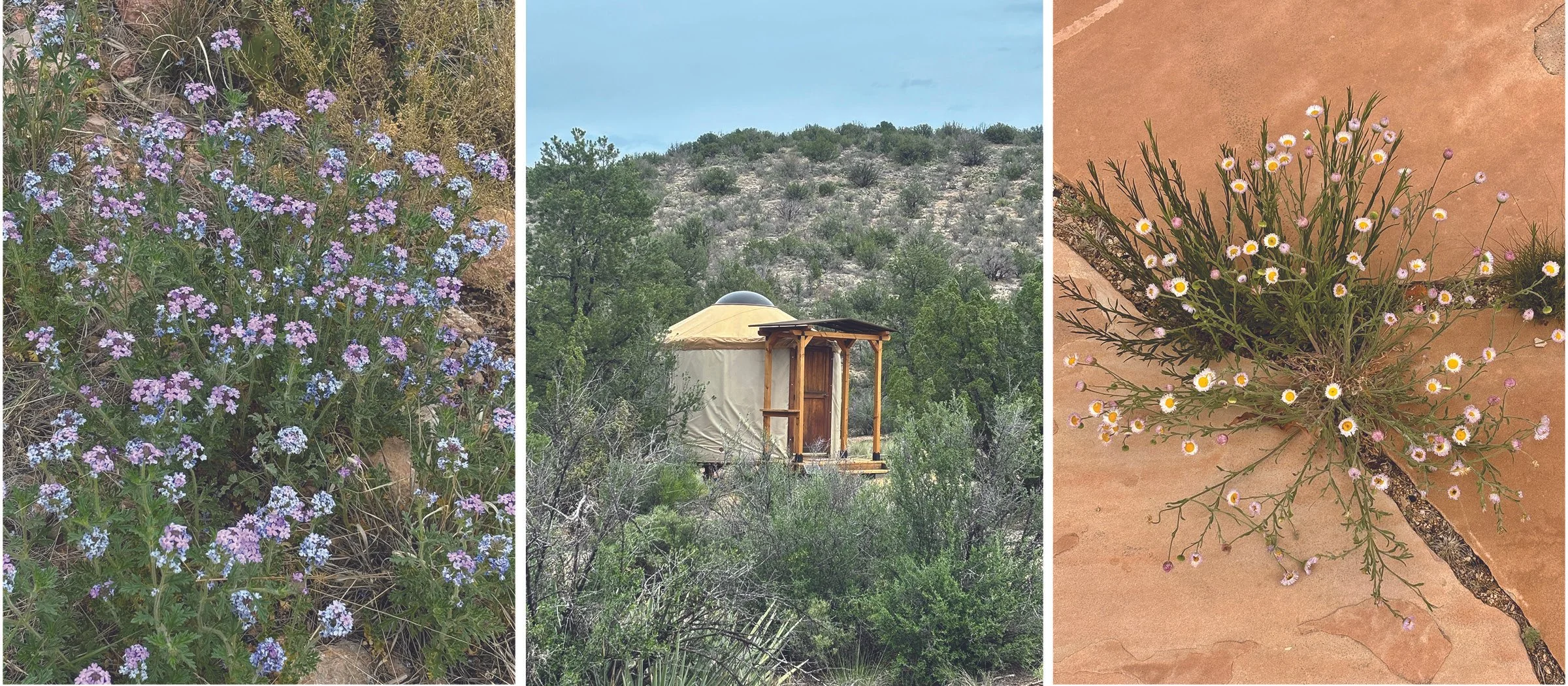
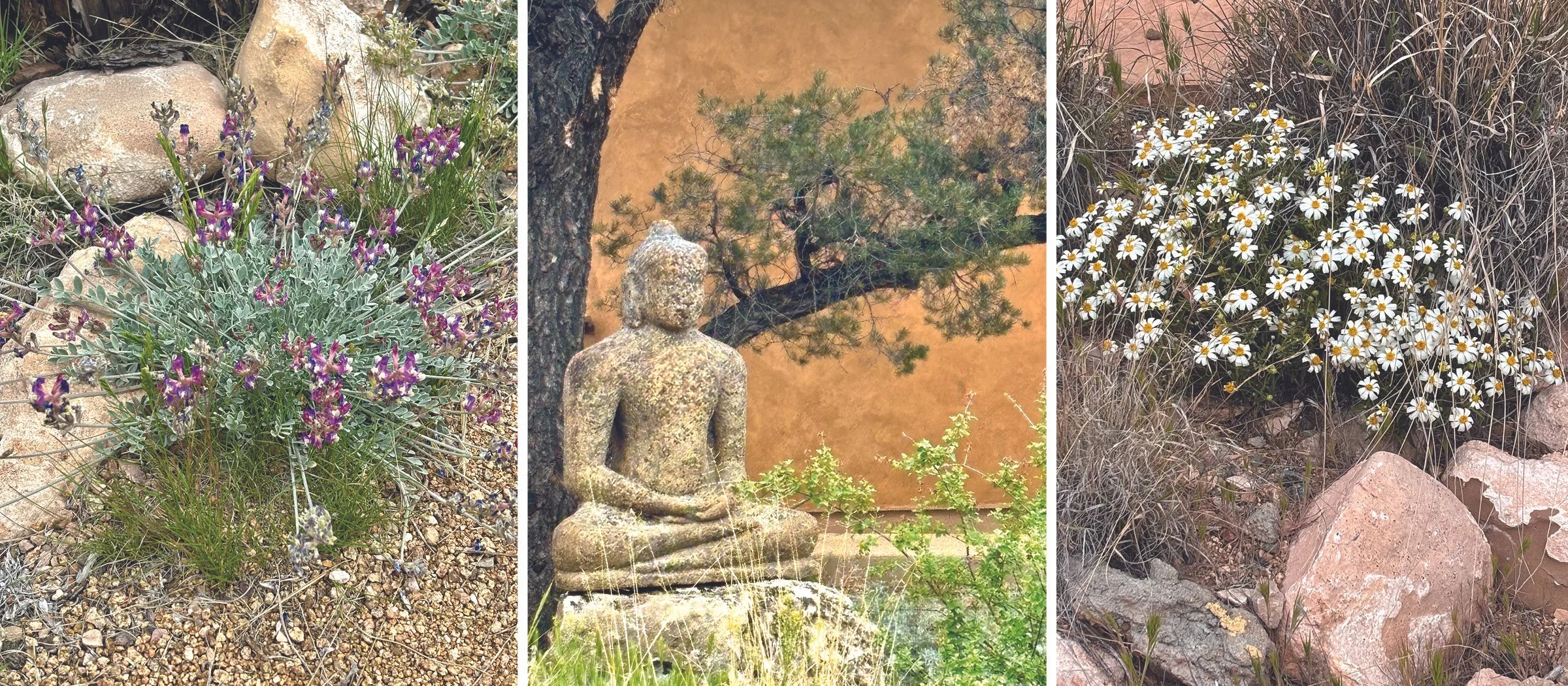
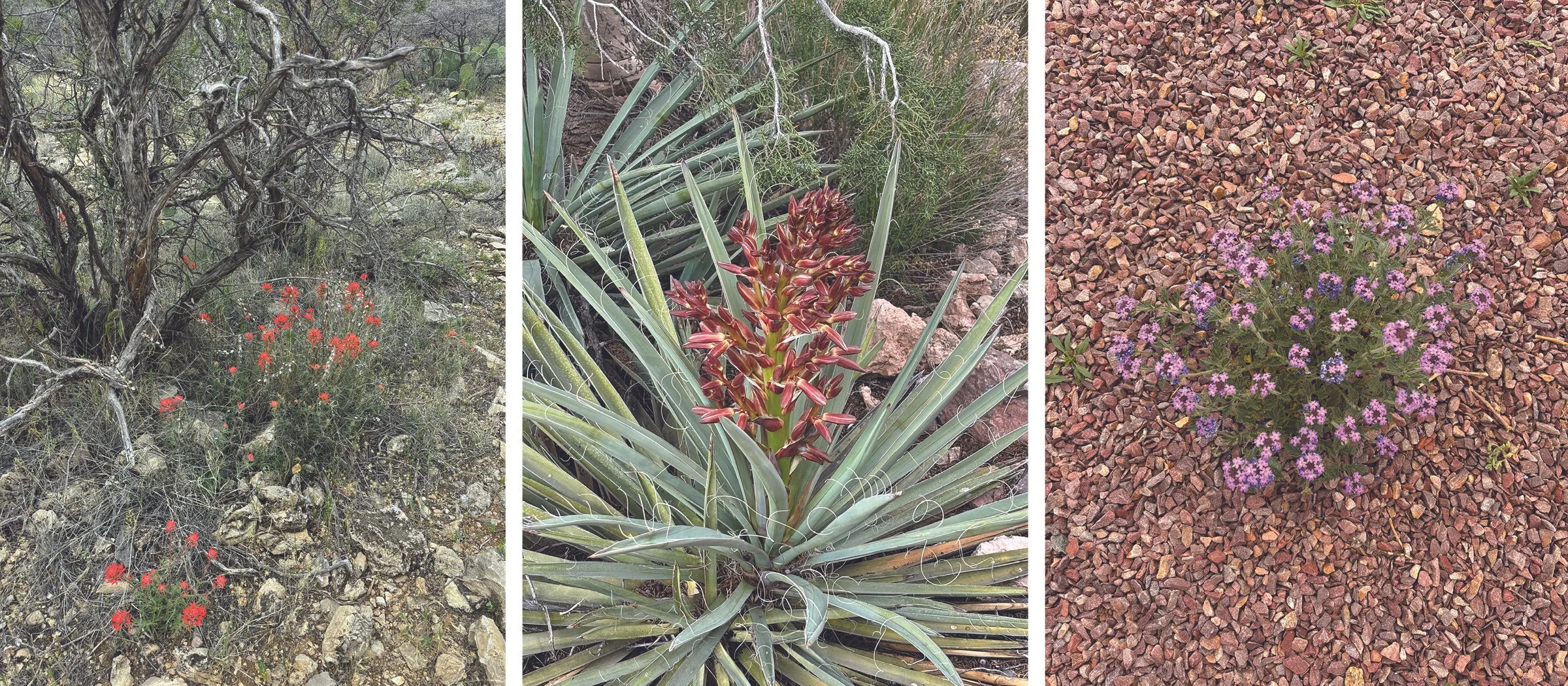
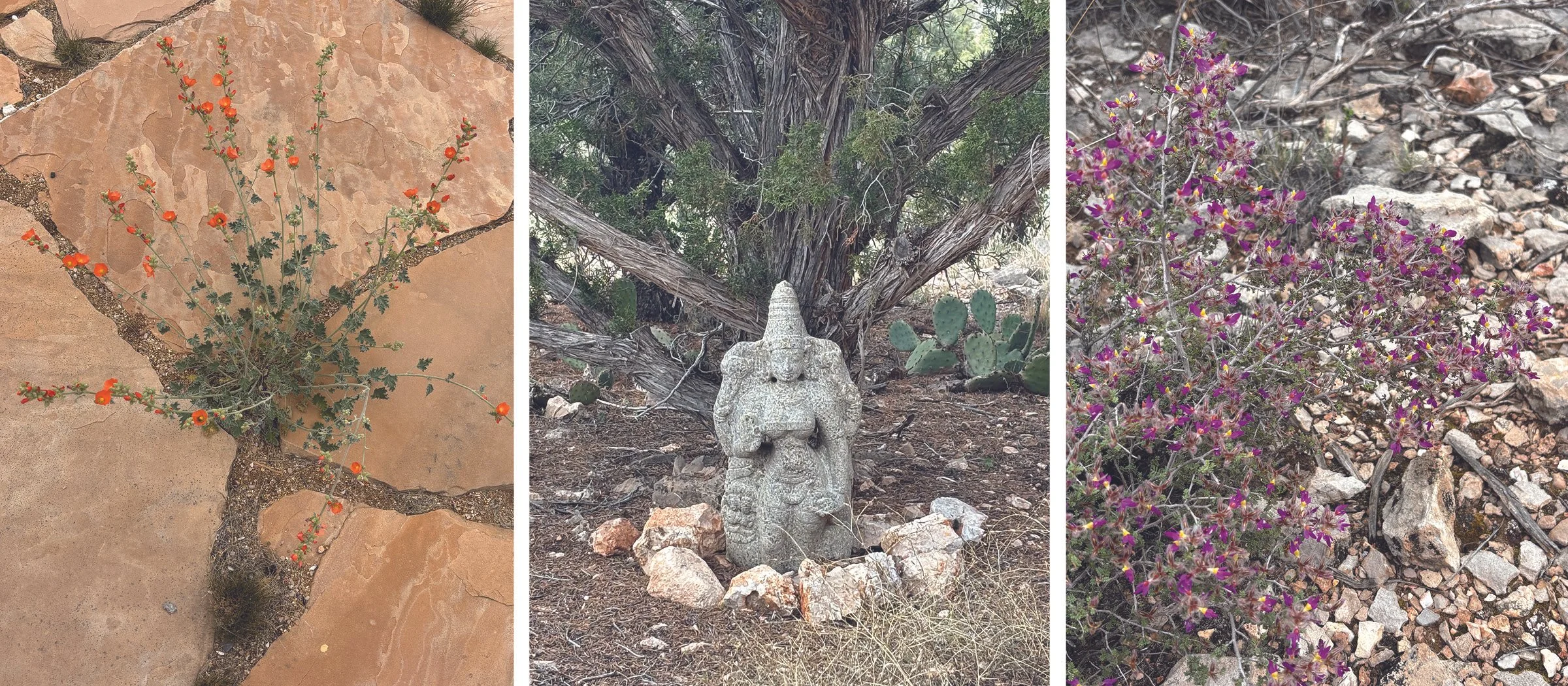
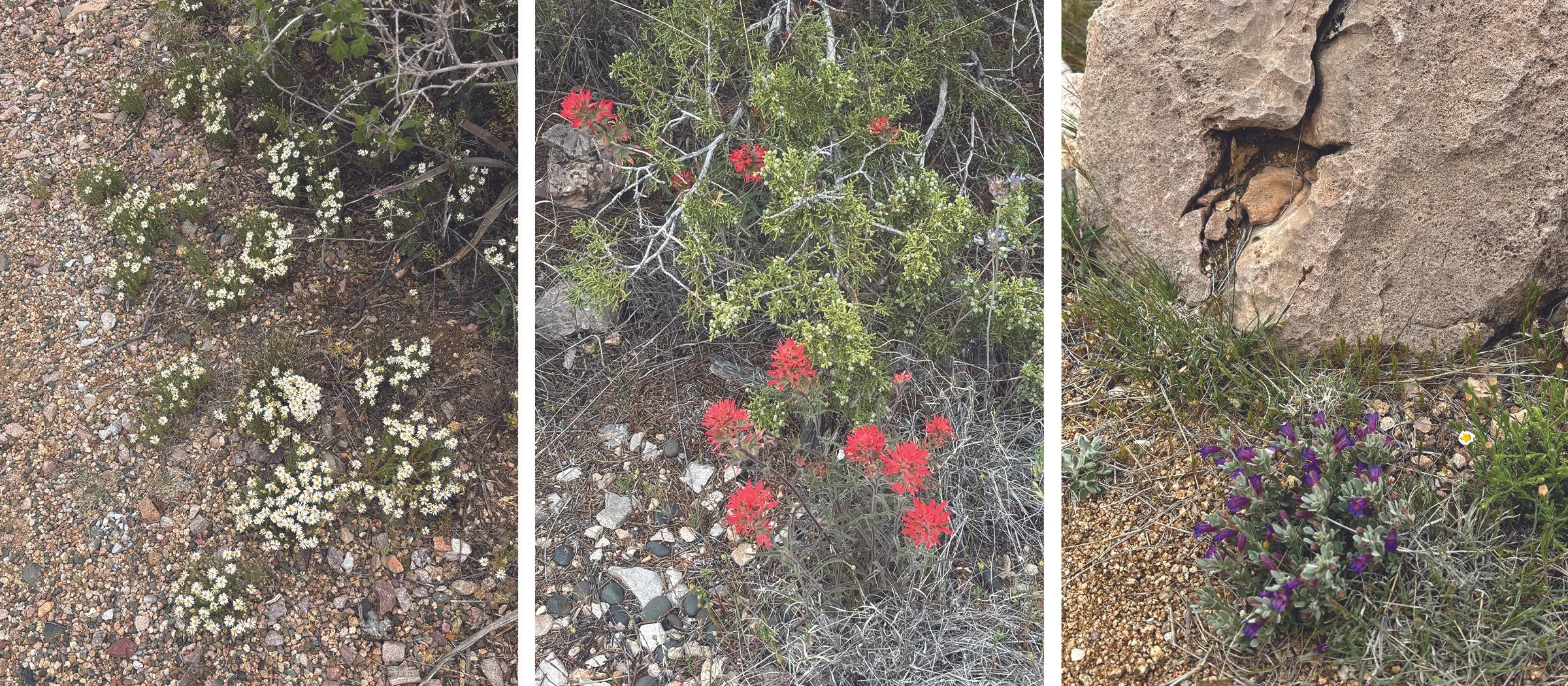
The photos that accompany this blog capture annual signs of spring in the high desert. Persevering in a rocky, rough, and climate-challenged environment, these wildflowers are living symbols of resilience and creativity in humbling and difficult circumstances—themes of the spiritual path that Mic explores in the following blog post. Photos taken on Triveni in early April, 2026.
I’m fresh out of retreat in the high desert at Triveni. I feel tender, peaceful and relaxed. Naked, an unleaded version of myself, completely caffeine free. May not last long. I came out of retreat today, midday Thursday and into the decompression chamber and a magnificent lunch with Nara at the beautiful retreat house.
So, what did I do the past eight days? Regina’s words on how to start a retreat remained with me… “Stay in one place. Make no sudden moves. Await inspiration from silence. Wait for what arises. It's all in your heart. …”
It's useful to hear how others use the space of solitary retreat. I need structure. Traveling to the U.S. from Australia, even after the five-day writing retreat and a week of jet lag, I remained very disoriented by time and space. It feels good to fill the morning with the more disciplined tapas of retreat practice. Waking has been variable, usually between three and five am. I sit until sunrise, which occurs now around 7:10 am. Then I do an Agni Hotra fire ceremony with the rising sun, making offerings of chanting and prayers. Then tea, more sitting and one hour of yoga before lunch.
Afternoons can be what they need to be. After lunch I wash up, chant mantra, walk for thirty minutes down the dusty road to the front gate, chanting along the way. Ram Ram Om Shri Ram… Then a couple more hours of sitting and mantra walking, concluding with a restorative yoga session before dinner arrives at 6 pm. In the evening, I write and read and am usually in bed by eight pm. Most days there are about five hours of sitting meditation plus two hours of yoga. That might sound like a lot, however in retreat with the early morning start, it’s very manageable.
There comes a moment along the retreat journey where the earlier disturbances—the accumulated stresses I brought into retreat—settle down. For me these were work-related trauma dreams and caffeine withdrawal. Distraction dissipates like the swirling snow I encountered upon arriving at my retreat hut. And then, like the fleeting deer, a deep embodied stillness arises, the desert language. A silence singing with the rocks, the ancient junipers and pinyon pines. It's a stillness where there is no urgency, no distraction. I am not being held hostage by my phone. There is no recoil from the latest podcast, and no outrage I must metabolise from news on Youtube.
From the clamour of my life emerges a deep ringing silence. It's a state that takes me beyond. An easeful, peaceful beingness. An elixir so intoxicating, simple and sacred, so deeply wonderful. The Goddess blesses me with a radiant stillness such that whether I am sitting, mantra walking, practicing yoga, or sitting in the sun drinking tea, there’s only the fullness of being. The mind stream becomes a whisper or falls entirely silent. Then there’s only the euphoria of This. The sun passing above, the moon, the stars, the deer and ravens. The fox creeping past gently one morning, with his black fluffy tail and brown feet. Somewhere out there is a mountain lion. All flowing in desert stillness against the cobalt blue sky.
This spaciousness that you are
Is permeated by luminosity
Know this radiance
As the soul of the world.
— Radiance Sutra V
In retreat I had time and space to write about the themes that have been coming up for me—fear and distress of my own, of the sangha, of the community, in the world. How do we hold onto silence and calm in everyday life? How do we remember to self-regulate with all the news coming in so hard and fast? How do we hold our distress?
How do we stand behind the waterfall of modern life, which is now layered with complexity and intensity, which is intentionally generated to overwhelm, confuse and perplex us (and largely not based in Reality)? Fascist regimes rely on fear to freeze resistance. How can we pass through paralyzing fear to feel empowered and able to respond?
Mountain lions come in many forms. Each night, alone in a wilderness, with my little head torch on my little desk in the retreat hut, with a pencil and paper, I sat down and wrote.
When I came out of retreat at Triveni, I gave a talk on the ashram based on my writings, which I titled “Fear and Faith on the Sacred Way.” I started with two passages from Lee Lozowick that set the context for the reflections that follow:
The suffering in the world at large is not lessening in quantity or intensity. I think that in our lifetime the lie, the illusion the massive darkness and the illness of the refusal of Truth and Reality as it is will only grow more, as will peoples’ general tendency to take it all hook line and sinker. The suffering is likely to increase as people in general continue to be confronted by crisis, by strange behaviours as people go mad from tension and stress, from war, violence, senseless fundamentalism political and corporate idiocy, greed and criminality, natural earth and sky upheavals, financial challenges, undiagnosable and virulent illness, all around confusion, doubt crises of faith and so and so on. You will want to have your practice together. You will want to be stable and strong and clear in your intention, attention (and not addicted to e-tension) and be able to pray profoundly for all that you can’t do anything about hands on. Never mind being fearless. If you are God bless your lucky ass! Mostly just be prepared to do the right thing fear be damned and the torpedoes too if necessary.”
And quoted in Mary’s book, The Art of Contemplation:
I realise it's more than a lot to ask of you, this Sacred Way. I ask you nonetheless. I am very anxious. I have seen the coming times. It is not only that you need God, it is that we need one another. Need! Not even as food or shelter but as deeply, more deeply, than the very air we breathe. You must consider loving God in an organic total way or life has no meaning. This I know heart, flesh, blood and soul, chemically and cellularly. Existence is meaningless if you don’t reach the Heart of God.
Fear and Distress
“In the full intensity of the present moment,” writes Zen priest, poet and writer Norman Fisher, “there is never anything to fear. There is only something to deal with. It's a subtle point, but it's absolutely true. The fear I experience now is not really present moment based. I am afraid of what’s going to happen.”
Buddhist teachings offer me great insight into working with fear and anxiety. When I am afraid, I contract, I push away, I react for survival. My distress and pain increases, my awareness decreases. Yet turning toward the fear increases awareness and decreases suffering, if we have the training to be with discomfort. In this moment there emerges clarity. In that gap, intelligence and wisdom arise. We know how to make the next move.
It's a paradox, how turning towards the stressor—the fear, the anxiety, the threat—sitting with it, and breathing down regulates the body’s nervous system. Our nervous system infrastructure is programmed to react to threat for survival. This reaction sets off a whole chain of responses that are largely unconscious. Judgement is the rocket fuel that drives the whole causative chain of negativity, known as rumination which, unchecked, will cascade into fear, anxiety, panic, and even constellate into the shadow of depression. The process of turning towards is the basis for all mindfulness practice. Resting in the present moment disarms the threat of survival by relaxed attention without judgement.
(I wrote at length about the Buddhist mindfulness practice of metta—loving kindness and opening the heart—in a retreat I made last year in Australia. It was posted in 2025 in the Sahaja Blog and is available to read. As always, metta practice was alive for me in my high desert retreat this year. Metta is a foundation that sustains me in my chosen field of work … more on that later.)
In 1990 Nelson Mandela was released from twenty-seven years in prison in South Africa, when he declared to the world that the march to freedom is irreversible. He visited Australia to express gratitude for our support. I went to see him speak at the Opera House forecourt steps. Five thousand people showed up. He stood on the dais looking across the crowd, then remained in silence for three to five minutes. It was a powerful demonstration of holding space, of presence over power. You could hear a pin drop. The sense of unity was overwhelming. The relational field of the nation began its healing.
In 1998-2000 OTPUR, a creative street theatre group in Serbia, led the resistance to the Milosevic government, which led to the downfall of an oppressive regime. These are larger examples of how the heart and peaceful nonviolence inspired change in dark times. On the micro scale, we have daily opportunities to reduce fear and align ourselves toward inspired change.
Small unconditional acts of kindness.
Connection before correction, rebuilding relationships even in the face of conflict.
Non escalation.
Breaking silence.
Moral courage. Martin Luther King’s ethic of love.
Recognizing the humanity of the other.
Hope
Context is everything. In 1966 Thich Nhat Hahn traveled from Vietnam to the U.S. His country was being destroyed. There was widespread destruction of villages and images of children running through napalm clouds. He came to speak about war, but more importantly to speak about peace. Martin Luther King heard him speak at a conference in Chicago. They only met briefly. The following year MLK nominated TNH for the Nobel Peace Prize. In his nomination letter, King wrote that what moved him the most was Thich Nhat Hahn’s teaching that peace work requires inner transformation, not just political action. (From Manoj Dias, “What Thich Nhat Hahn taught MLK.”)
Both visionary men were watching their worlds fall apart. King was facing death threats daily, loosing allies, watching the movement fracture. Hahn’s monasteries were being bombed, his students were being killed. They had every reason to despair. Every reason to give up or give in to rage and hate, but they did not. The teaching that Hahn gave King and gives us now is this: Hope is not a teaching. It is a practice.
The Buddhist teaching of impermanence speaks to this. Everything changes. Always. No matter how solid it appears, nothing stays the same. It is lawful for the carnage and suffering we are currently seeing to transform. The question then is in which direction will this change? I understand the fear this creates. Yet impermanence cuts both ways. Just as injustice can deepen, it can dissolve. Just as darkness can spread, light can break through. The question isn't whether change will happen. The question is, what am I doing to shape what comes next?
Thich Nat Hahn showed Martin Luther King that hopelessness is a form of arrogance. It's the belief you can predict the future, that you know where the story ends. But you and I don’t know what’s ahead. None of us do. In one year, in three years ahead what will happen? King said, “The arc of the moral universe is long, but it bends towards justice.” When darkness is overwhelming, the arc requires our attention and our presence to move it towards light. The key word is long. Not immediate. We are playing the long game, and this is especially clear when we are students of deep spiritual work.
Here’s how it becomes a practice for me. When everything feels hopeless, when I feel like I’m drowning in news of another senseless death and the casual cruelties of current times, I return to the question: What is mine to do now? Not what I can “fix.” It’s clear that you and I cannot save everyone, much less the world. But what small specific action can I take that moves the needle in the direction of dharma? In the direction of sacred values of peace, inclusion, compassion and love?
We go out and sweep the path, we chop firewood and tend to the roses. The arc, the flow of energy, the wheel of dharma is turning, and the river of time is moving.
For Thich Nat Hahn, it was teaching one group of monks how to rebuild villages during the war. For King, in his darkest moments, it was writing one letter, making one speech, showing up peacefully for one march. They didn't wait to feel hopeful. They acted and their action created its own momentum. Thich Nhat Hahn called this “Being Peace.” Not waiting for peace to arrive but embodying it in how you move through the world. How you speak to the person in the store, how you breathe when the news feels unbearable, how you show up for one person, one moment, one decision at a time
The tantrika is obliged to transform. We do this by how we use our attention in relationship to fire, water, air, earth and space. To our minds, our relationships to our families and our work. Our practice lives are light in the darkness. — Lee Lozowick
Our lives of spiritual practice are a light in the darkness. Our dedication brings love, light and beauty into the world. Our daily lives are tempered in the fires of devotion, in the fires of our times. The devotion and dedication I see in my sangha bakes a sweetness into the sourdough of our lives.
I can barely believe it's been twenty years since I first met Lee. And what a joy it is to return to Triveni Ashram every couple of years; to see the sangha, each one a more distilled versions of themselves, more molten and surrendered. The practice of the sangha is a wonderful gift to me. Their practice brings light to the darkness.
Poet Adrienne Rich said it so well, fifty years ago:
My heart is moved by all I cannot save.
So much has been destroyed.
I have to cast my lot with those
Who age after age, perversely
With no extraordinary power
Reconstitute the world.
Social Work
A monk asked Yunmen, “What is the teaching of a lifetime?” Yunmen replied, “An appropriate response.”
At the heart of my profession, social work, is the consideration: What’s an appropriate response? When meeting the suffering of the world, this exchange with the Zen master Yunmen has become a mantra, a deep enquiry, an invocation, a koan, a prayer for me. Mental health social work is an alchemical chamber, where I show up in the world and turn towards suffering and distress to express kindness, generosity, and compassion. Now there are no distinctions between my working life and my spiritual life.
In the past two years I have worked as a first responder with police seeing people in suicidal crises. It’s a unique window into the world of suffering. What’s an appropriate response? How do I respond to the anguish, anger, pain, panic that I encounter? I meet the person’s eyes calmly so he or she can feel that I am fully present. I feel your anger. I am here to support you. Take a breath. Bring it down, mate. I listen. Don’t we all just need to be heard? Aren't we all traumatized, in one way or another? Aren't we all just lost socks in the laundromat of oblivion?
An appropriate response. A central tenant of trauma informed care is offering safety and sanctuary, before all else. I’ve become somewhat of a specialist in this domain, which extends to the necessity of my own self-care. It’s imperative that I take measures to reconnect to my inner core, which is so much larger than the travails of social work. Perhaps that’s why spending a week alone in a retreat hut high in the desert mountains in another country is so appealing.
Then there’s the sanctuary of my bathhouse. I encourage you to rush out and buy magnesium flakes, not Epson salts, and take hot baths daily! Soak in boundless bliss. Try the miraculous power of Ayurvedic abhyanga warm sesame oil self-massage before a shower, to calm and clear anxiety when the vata (air element) that so easily becomes deranged. Meditate, move your body. Rest. Take more rest. Have craniosacral sessions, bodywork. Walk. Solvitur ambulando: It is solved by walking. Find a heartful therapist you can work with.
Or if all this fails, buy yourself a motorcycle. I agree with Krishnamurti, who liked driving his student’s BMW in Europe. He once declared to an attendant that his meditation began at a hundred miles per hour. He said, “This is how I save the world.”
So, I imported a Royal Enfield 450 Himalayan adventure motorcycle. It’s one of the best things I’ve done for my health in the past two years. My son Bodhi and I ride together, including a pilgrimage to our friend Michael Menager’s remote farm on the south coast of New South Wales. I’ve been back solo twice since then. On the last journey I took a leisurely, ecstatic week, stopping at pubs overnight, riding quiet back country roads, filling my helmet with chanting and pranayama, returning over the snow-covered Australian alps.
When I am showing up, along with the police, at a home or situation in crisis, there is often chaos, extreme emotion, confusion, and a searing intensity that I have to manage within myself before I can respond appropriately. These are situations marked by high degrees of intensity and overwhelm, with my own adrenalin and fear responses kicking in. In all these moments I use my superpower, which is the name of Yogi Ramsuratkumar. I breathe, remember nama, and wait for that gap of clarity and wisdom to emerge. Then the next step—the appropriate response—becomes evident.
Yoga
My other practice over the past eighteen months has been training as yoga teacher. I had no intentions to become a yoga teacher. For a time, I was not metabolising all the suffering I was experiencing. I had high blood pressure and high blood sugars, too little exercise due to the impacts of relentless stress. I was burning. I needed to create necessity for practice.
So found a teacher in the U.S. from the T.K.V. Desikachar tradition and signed up for a yearlong, five-hundred-hour teacher training. Once again, I was moving and breathing in ways aimed to calm the nervous system. In the process, I came up hard against my lack of integration, my wounding and all that emerged from working with an aging inflexible body. But when you plug attention into the body in this systematic way, something else grows.
Yoga has become an invitation to not arrive, to rest in the sacred world by focusing on relaxation and letting go. The focus is not on attainment, alignment or the perfect pose; it’s on relaxation and letting go. Kindness, generosity and compassion, elegance, refinement and truthfulness, non-harming, stillness, conservation of energy, gentleness, peacefulness—these are the aspirations that constellate over time into a state of fullness, a state of samadhi. We might also name or call it “integration.”
Transformation is a slow steady work that takes time. We need to rest in silence or at least make some efforts to touch there. Otherwise, we remain subject to the relentless distractions of mind and ego that cannot fully express the natural state of sahaja, the fullness and non-duality of being. In the Yoga Sutras, Patanjali suggests that when consciousness settles to the point that it can reflect pure awareness back to itself, it can then express its fullness and radiance. This exalted state is an integration of body, mind and spirit that is refined with humility, love, compassion and connection. We need more of it.
Be conscious of this unconscious prayer (of your breath)
For she is the most holy place of pilgrimage
She wishes for you to enter this temple.
Where each breath is adoration
Of the infinite for the incarnate form.
Everyone who breathes is adoring the Goddess
Know this, and be in great joy
Listen to the ongoing prayer that is breath
Life shall dance in you
A dance of ever renewing delight.
— Radiance sutras V 154-56
Yoga’s strongest evidence of benefit shows in the endocrine system, lowering cortisol (stress hormone) and increasing wellbeing, which is what I need in my working life and what I cherish and nourish in my personal life. Time on the mat becomes a metaphor for what you experience cognitively and psychologically in your life. In cultivating resiliency through yoga, I’ve learned how to rest. I’ve learned the core value of slow breathing and self-observation, how to stop the war with myself by bringing kindness and acceptance to all experience. With practice I’ve learnt to abide and manage uncomfortable feelings, to increase my distress tolerance. I have much greater access to self-compassion, and self-acceptance, which supports working with others in a cycle of caring.
Another major ingredient in building an alchemical engine to engage the inner work is diet. People tend to be quite zealous and religious around diet, especially in spiritual communities. Speaking from my own experience what has made all the difference is changing over from a carbohydrate fueled diet to a fat fueled diet, more aligned to a keto style of eating. It’s been a game changer in terms of energy and clarity. I agree with Lee, that it takes a lot of energy to run an alchemical engine. I disagree with him that a vegan or vegetarian diet is optimal. Beloved sangha and friends, listen to your own body. Make sure that your engine is burning clean and nourishing you deeply, according to your needs.
This Sacred Way …
“It’s a lot to ask of you, this Sacred way…” says Lee. Some days I feel I am a warrior of compassion, and I can express my practice in the world with clarity compassion and calm. I can get out there on the mean streets with all the noise, chaos, fear and aggression, with Hanuman beside me and Yogi Ramsuratkumar’s name in my heart. But then mostly I’m just an introverted yogi who would rather lie low and wait out the storm.
How open, relaxed, heartful and grounded am I in the face of fear and breakdown? Lee was continually sacrificing himself so we might learn to access the hidden jewel, the hidden beauty within ordinary life. He was embedded in “the rag and bone shop of the heart” (as poet John Keats once wrote). So, the Sacred Way brings us to how we respond to Just This, what is, as it is, here and now.
Not only do we have Yogi Ramsuratkumar, the Master of the Universe, as our cosmic benefactor, but there is also Lee’s extraordinary blessing field and street wisdom and decades of transformative work together in community. What an extraordinary treasure we have at our disposal, to meet these times, and walk together the Sacred Way. I wish for each of us strength, fearlessness and community.
At Triveni the silence and intensity we encounter in retreat draws out toxins, fatigue, fear and all the noise we absorb from our cultures. When this noise begins to settle, there remains only the luminous silence, the breath, the presence and majesty of the desert, the simplicity and spaciousness of Being. When the dust settles, what we have, by any other name, is the Divine. I pray that I can carry this back into the world, that this sweet stillness remains in my bones. To be able to carry this into the storm is a treasure beyond compare.
Retreat practice is deeply healing and restorative. It is a reset for the heart and mind of the weary traveler. Triveni is a jewel hidden in plain sight. For those who live near, you don’t have to travel 12,000 miles across a vast ocean to access it. Use it. Engage with retreat practice, even if only for a few days. Theres nothing to be afraid of. As I was, you will be held. Enter deep time and peace. And bring back some light to offer the world.
Like the stars over the dark fields
Love is a gift of the eternal forces.
We do not know why it appears.
It is just a song the universe sings to itself.
And like other beauties, it is a demanding guest.
As soon as love arrives, we have to serve it.
We were naked and now we must put clothes on and work.”
— From The Light inside the Dark by John Tarrant
Mic
Triveni Ashram
February 26, 2026