
The Practice of No-Practice And the Grace of Ramana Maharshi
And a woman who held a babe against her bosom said, Speak to us of Children. And he said:
Your children are not your children.
They are the sons and daughters of Life’s longing for itself.
They come through you but not from you,
And though they are with you, yet they belong not to you.— from “The Prophet,” by Khalil Gibran
It was the year of 1981. I was twenty-one years old, and I left my worried parents behind to hitchhike to India from the Netherlands where I was born. Despite their concerns, my parents were so kind to take me all the way to south Germany by car to give me a headstart, a good 700 kilometers away. There they left me on a nice hitchhike spot near a highway. We waved until they disappeared out of sight. What a journey it is to be a parent!
Many years later, I am blessed with a daughter myself now. A bright delight of a young child. She grew up in a yoga retreat center in Spain, amid nature and animals and people who loved her. She loved it there. When she was eight and a half years old, we moved to Holland, thinking that she would more easily make friends here than in conservative Catholic southern Spain. The first years this was also the case; she seemed to adapt seamlessly to her new life. But it was at the onset of puberty that clouds began to gather around her soul, dimming her light and bringing to the fore more problematic predilections. Despite the help of psychologists, family therapy and her parents doing their own individual therapy, it was evident that she was on a slippery slope downhill, escalating in serious destructive behavior when she was fifteen years old.
We have wondered no end what could have caused such a dramatic turn in her personality. For sure both of us, as her parents, carry our own package of traumatic material, which for sure explains some of the emotional difficulties. Yet beyond this we are still left wondering. No expert that we consulted, no psychologist has been able to shed any real light on the question. The Buddha apparently said that attempting to analyze all the causes and conditions that constitute a certain event in life would drive someone literally mad, so impenetrably complex is the web of karma in the timeless eternity of conditioned existence.
But as a father of a fifteen-year-old, with whom I otherwise had a beautiful father-daughter connection, to see my daughter slip through my fingers like sand, into self-destruction, without being able to reach her, stop her, guide her, has been a grueling experience. I hadn’t slept a solid night’s sleep in about a year. At this point no spiritual instruction or wisdom teaching helped me to alleviate the worry and pain.
“Go to Tiruvannamalai, go to Ramana,” said a soft voice inside. As the months passed, the voice kept softly reminding me, until the moment came when I was able to heed the call.
India has always been a place of refuge and spiritual growth for me, and I’ve spent quite a lot of time there throughout my life. I’ve grown to love India, despite all its hardships that inevitably come my way as I’ve ventured deeper into her bosom. It is exactly those hardships, which are so omnipresent, that give rise to one of India’s noblest features, which she offers like a shining diamond to the world—namely, acceptance and surrender. If there is one feature in the culture that the people of India embody, it is this good-natured disposition towards difficult, challenging and at times even hostile circumstances, which is possible only with a profound ability to trust in the unfolding of life. I first encountered this when I was a young, twenty-one-year-old, freshly arrived in India, when I befriended a leper whose body was being eaten into oblivion and whose eyes shone like the sun.
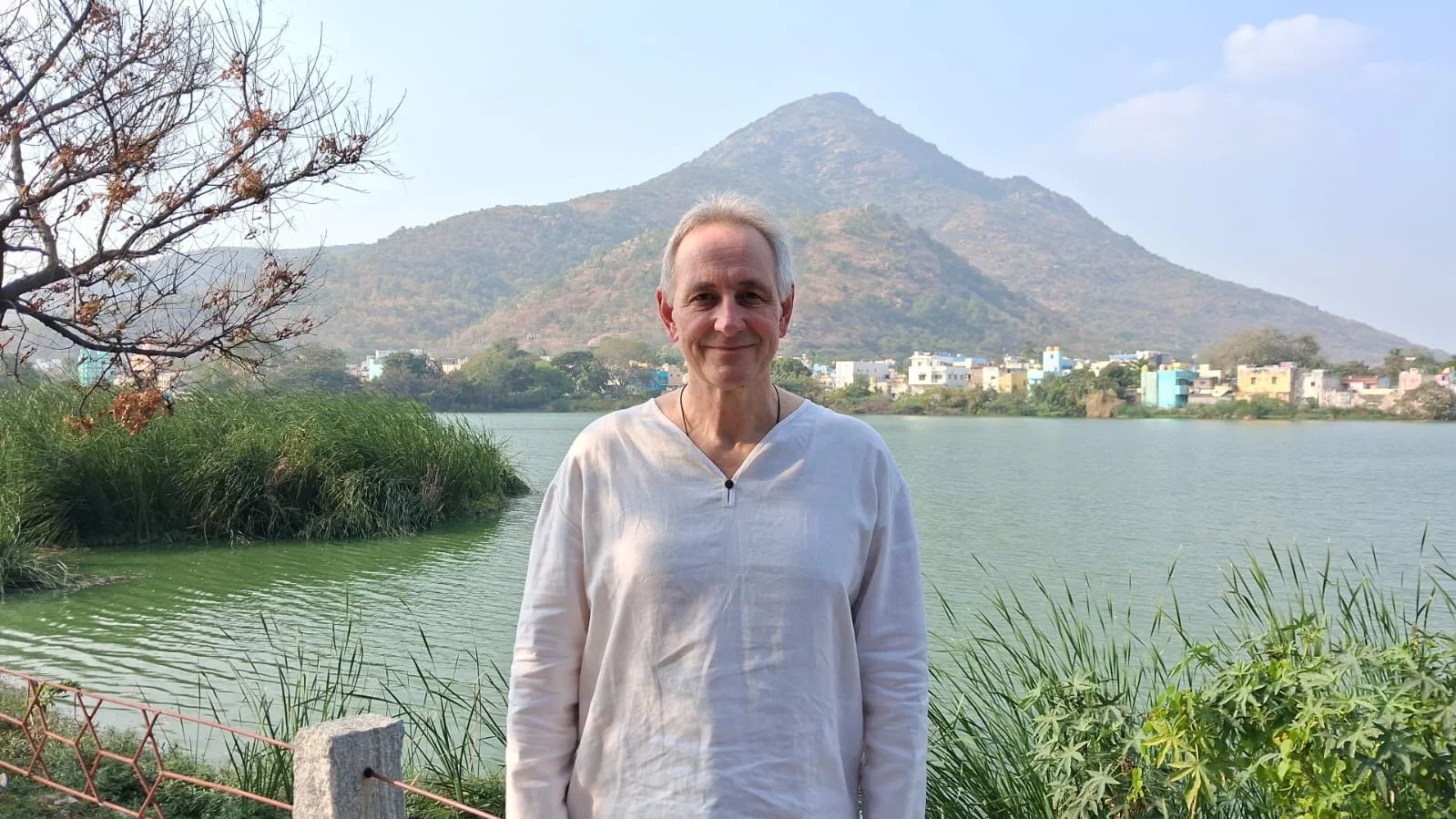
Harry in Tiruvannamalai with Mount Arunachala behind him.
It had been ten years since I had last been in India. An old friend who I have not seen in twenty-five years welcomes me in Tiruvannamalai. Of course, the first thing we do is drink a cup of hot chai in a chai-stall along the road. It is a joy to see her. She shows me her apartment with a glorious view from her rooftop terrace of “the Red Mountain Arunachala,” the sacred hill that Ramana Maharshi was irresistibly attracted to as a young boy. It is late afternoon when I bid goodbye to my friend. I am not hungry and wander off through streets I know so well from previous visits, heading towards Triveni II, Lee Lozowick’s ashram. I am delighted to be able to stay there. Bruno, the manager, welcomes me warmly and we catch up for a while. Then it is time for a good night’s sleep.
I am wide awake at 4:00 a.m. Time to get up. Not much later I sit in the chai stall next to the Ramana ashram with a cup of hot chai. I love these early morning hours in India, when it’s still dark and the birds have not woken yet. Behind me is a large, covered space that used to function as a bus station. Now, many visiting pilgrims, sadhus and some homeless families find a place to sleep there for the night. The dogs are quietly going around their business. I notice that they look a lot better than they did in the past
A sadhu walks up to me and asks for a cup of chai. I oblige. There is something in the way he receives the cup of chai from me that touches me, as if he truly sees and honors the heart of our shared humanity. Sitting on a bench together, we drink our chai in silence. Then with a simple nod, and a short moment of our eyes meeting, he is on his way.
At 5:30 the gate of Ramanashram opens. About ten people are already waiting and we walk in. I go straight to the meditation room, which is the place where Ramana once sat on his couch and received people. I find a spot on the floor against the wall. Okay, I am here, and what now? I am only clear about one thing. I am not going to do any meditation practice. In fact, I am not going to do any kind of formal practice at all! I am much too exhausted. All I want is to rest.
I am very glad to be here, yet soon my mind gets filled with the customary stream of sorrow and anxiety. I let my mind do whatever it wants. Hours pass with the chaos of my mind’s habitual merry go round of conversations, arguments, shouting matches and disbelief over all that has come to pass in the last year. Worn out, I fall asleep for periods of time as well. On waking, immediately the stream of compulsive thinking resumes. Then one clear thought arises: My mind can do whatever it wants. I am not going to control or work with it in any way, but I am not going to engage with it. I am not going to indulge these floods of hugely emotional moods.
As I have this thought, a gentle breeze of peace wafts right through a crack in my chaotic mind. I am amazed. For a moment I dare hardly breathe. It is noon when I get up from the floor, my bum aching from the marble tiles.
Ramana Maharshi was one of India’s most celebrated saints of the last century. Ramana was not the only exceptional being in India at the time. AnandamayiMa, Ramakrishna, Vivekananda, Swami Shivananda, Paramahansa Yogananda, Meher Baba, Sri Aurobindo, J. Krishnamurti, and Yogi Ramsuratkumar—not to forget the great Nisargadatta Maharaj!— were all spiritual giants of that era. In fact, Ramana Maharshi was one of Yogi Ramsuratkumar’s “spiritual fathers.” What a rich age it was! And there were countless others.
What other country in the world produces such a plethora of saints on an ongoing basis? It is undeniable, remarkable as it is, that in the places where these people lived and passed away, the essence of their saintliness is still present as if they are alive today. How is this possible? I don’t know. But it is an undeniable fact. In the case of Ramana, there is a divine stillness and peace that continues to bless and liberate the hearts of many. It is as if he still walks the grounds of the ashram in a subtle form that reveals with absolute clarity one’s own true nature.
I come from a less than perfect spiritual line of teachers (to say the least) who have been a great influence in my life, namely Harilal Poonja and the American guru, Andrew Cohen. Even with Andrew’s well-publicized disasters as a teacher, the essence of the seamless divine nature that Ramana embodied passed through undefiled. It was this pristine and holy Presence that revisited me and reasserted itself in my heart. This Grace, this Love is not concerned with my shortcomings, inadequacies, overindulgences and the mistakes I may have made with my daughter or in other periods of my life.
Annamalai Swami was one of Ramana’s closest, most trusted and devoted disciples. He worked tirelessly for fourteen years in the ashram and was responsible for much construction work that he completed according to Ramana’s instructions. At some point Ramana gave him a corner property to enclose and create his own ashram. Many people came to visit him there and were blessed by him. I have always appreciated his writings and feel a connection with him, even as I never met him in person. His shrine is on this same property as he passed on in 1995.
In the next weeks of my stay, when it gets crowded in the meditation room, I walk over to Annamalai swami’s shrine. I discover that hardly anybody comes here, even though it is so nearby! I often sit here with one other swami who sits quietly in the corner. Occasionally an Indian woman comes in to perform a small puja for him with incense and a candle. A Japanese woman who spent the last years of Annamalai Swami’s life with him as a student, comes in daily to pay her respects. It is quiet here. There is an exquisite quality of stillness in the atmosphere that is hard to describe. It soothes my soul.
I meet a woman from Ireland who becomes a friend, Aine is her name. We meet once a week for the two months of my stay. “Come, let’s visit Sadhu Om’s shrine,” she says one fine day. I had walked past Sadhu Om’s shrine many a time in past visits to Tiruvannamalai but had never felt drawn to go inside. “Okay,” I say, “let’s go.” Sadhu Om was another of Ramana’s enlightened disciples. Sadhu Om, Annamalai swami, and the famed poet Muruganar had been the three main disciples with whom Ramana felt most comfortable. For that reason, you can see that they sit closest to Ramana in many photos of different gatherings.
The shrine is situated in a quiet back alley not far from the Ramanashram. On entering, Aine shows me some of those pictures, explaining as we go. When we circumambulate the shrine, on the other side, I see a large picture of Sadhu Om hanging on the wall. “What a beautiful picture,” I think to myself, as I quietly take in the image of Sadhu Om with a very relaxed expression on his soft face.
The next moment I feel myself drawn into the photo. The softest presence, which I can only call sacred, fills my being. “What is this?” I wonder as tears begin to stream down my cheeks. Never before have I been drawn into a picture with a force like this. I have never read anything about Sadhu Om or have any knowledge of him at all. What is this?
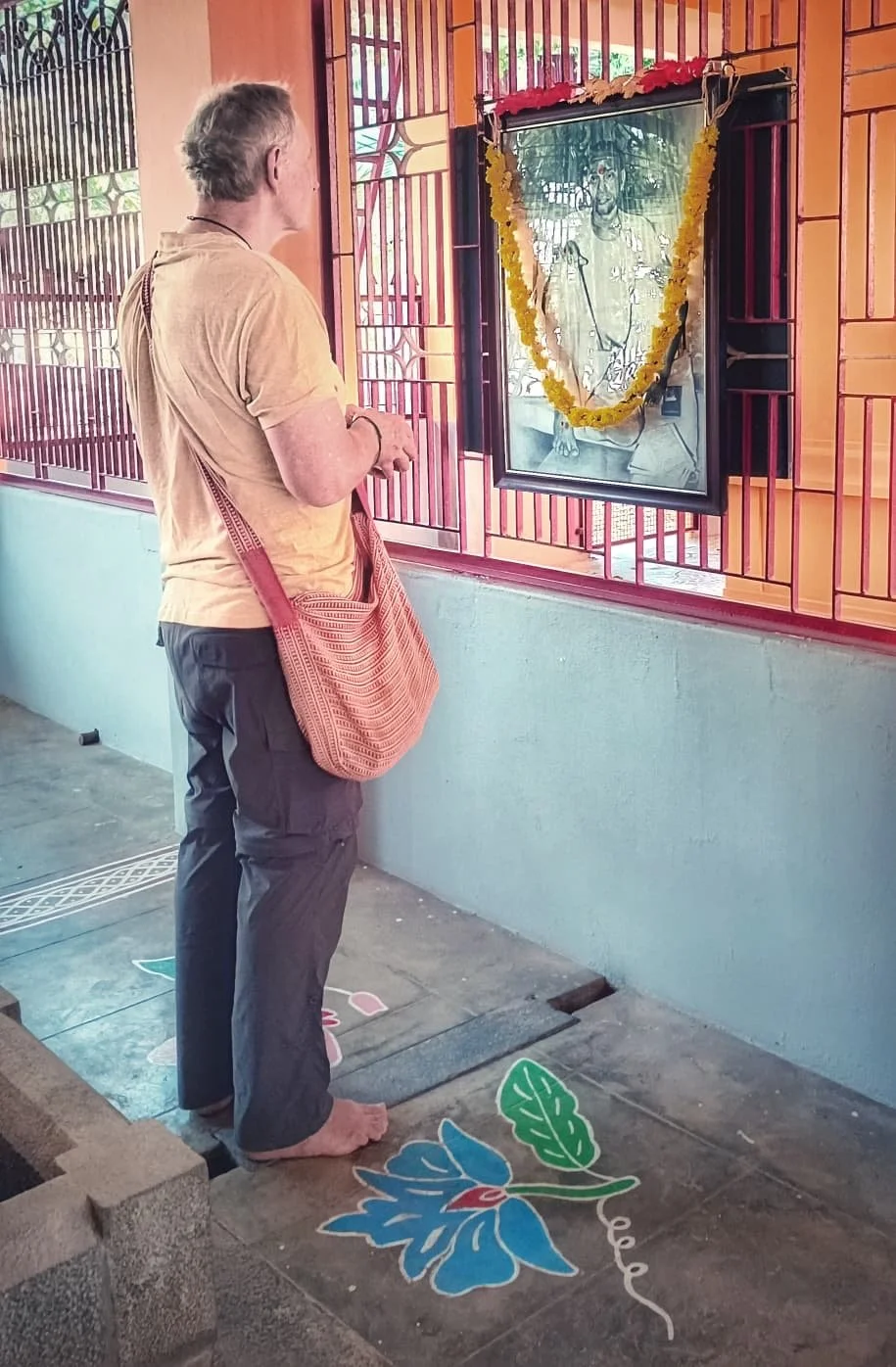
Standing in front of the picture of Sadhu Om.
Thick tears keep streaming down my face as they gently, effortlessly, appear. For about ten minutes this continues, almost thoughtless. I am awestruck and grateful. When my mind becomes a little active again, I sit down on one of the chairs in the shrine. Hours later I open my eyes. My friend has long ago gone home. She saw it all happening and knew I was more than fine.
What are these connections, these stirrings of the soul? What is this Grace that comes unannounced? And from those whose physical bodies have long ago passed away! In my case it is India, this storehouse of ancient spiritual power and knowledge, that has bestowed me with blessings since I was nineteen years old. Am I glad that I followed once again the call to come to Tiru.
From that day I spent every morning in between Ramana’s room, Annamalai Swami’s shrine and Sadhu Om’s shrine. From there I would go to one of the Indian eateries. After eating, I would take my motorcycle (a classic Royal Enfield 350 CC!) and go to a gym I found some eight kilometers outside of Tiru. What a delight to ride leisurely through the rice fields!
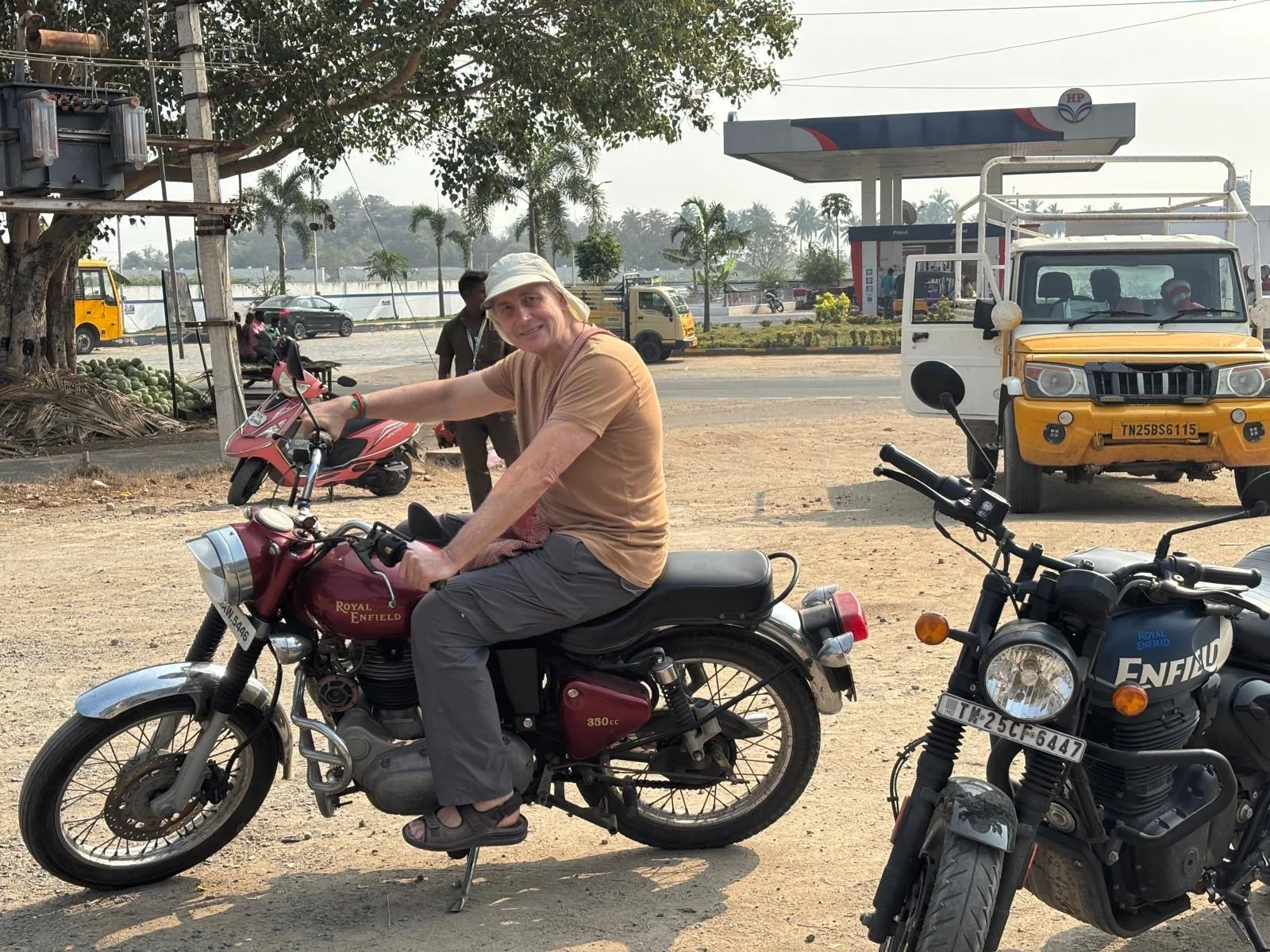
On his classic Royal Enfield 350 CC.
Afternoons were filled with meeting friends or sitting in the beautiful, evocative darshan room at Triveni II where I was staying. Because my friend Bruno loves Indian sacred art—like his guru, Lee—the darshan room is filled with amazingly beautiful temple statues of many of the deities of India, and here in the sanctuary of Triveni II, one is also engulfed by a sacred silence.
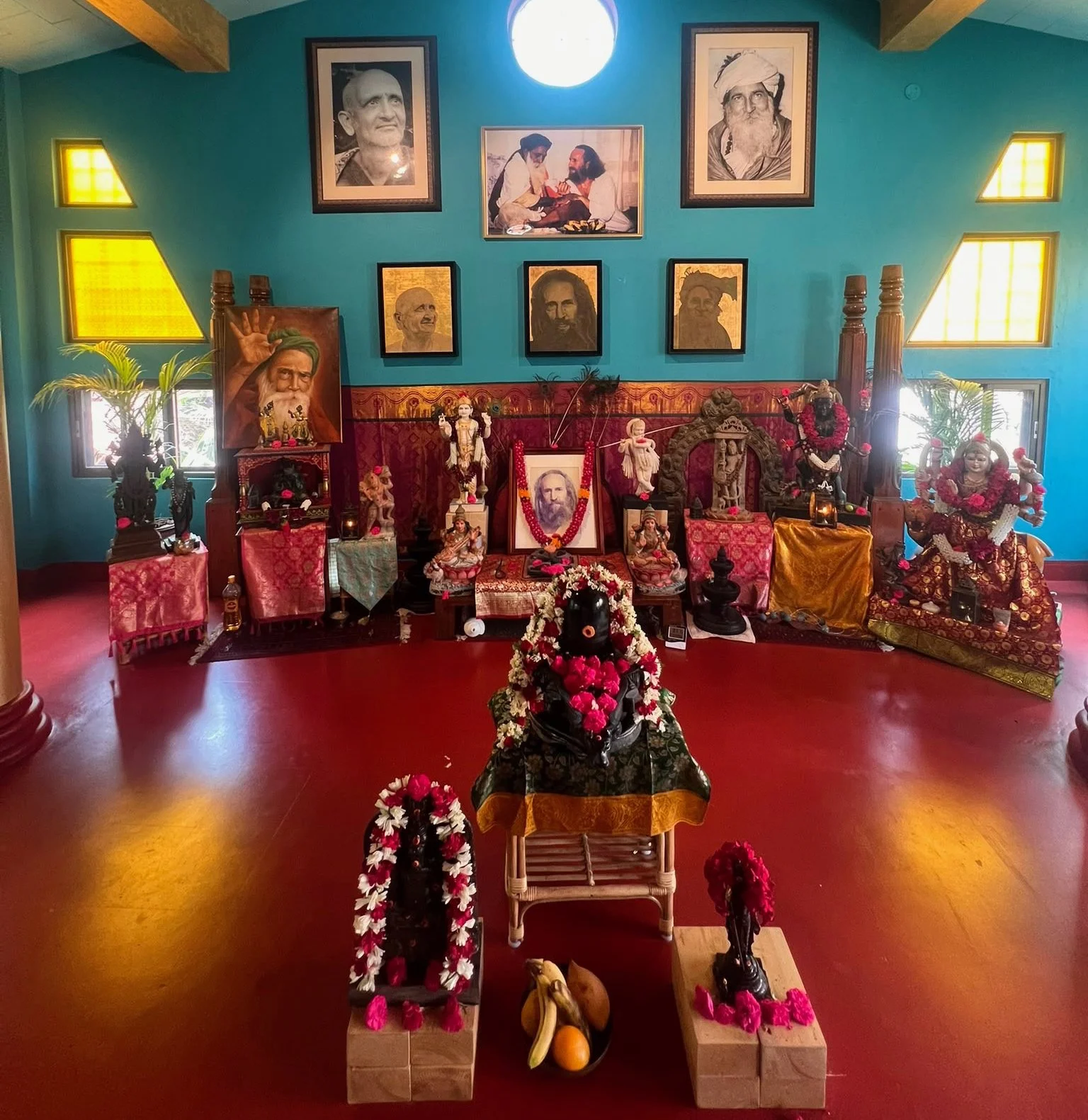
Darshan room at Triveni II in Tiruvannamalai.
One of the temples at Palokottu, a small tranquil area on the Arunachala Mountain next to Ramanashram, is another place I visit. In the old days many sadhus lived or came here—including Yogi Ramsuratkumar. It is said that Ramana often came to visit the sadhus and sit by the quiet waters of the pond. In all honesty it is not so quiet here nowadays, because the road is not far away and the incessant honking of cars and trucks make a huge racket. Despite this, the underlying silence remains unaffected.
India is still as it has always been. Where in the world can you wander from shrine to shrine like this, from holy place to holy place, from ancient temple filled with spiritual power to another holy temple filled with devotion? For two months I bathe in this environment filled with blessing power, like sitting under a waterfall of Grace.
Sometimes we need the support of an external sacred environment to overcome a challenging passage on our life’s journey. For me it was the softness of Ramana’s complete surrender to life’s conditions, and the imperishable divine peace he emanates, that healed my heart and my body. I came to accept my life and the actuality of the situation with my daughter. More than that, I came to peace with it. Not by any doing on my part. It was given to me as a gift, a huge blessing from Ramana Maharshi.