
The Alchemy of Nama
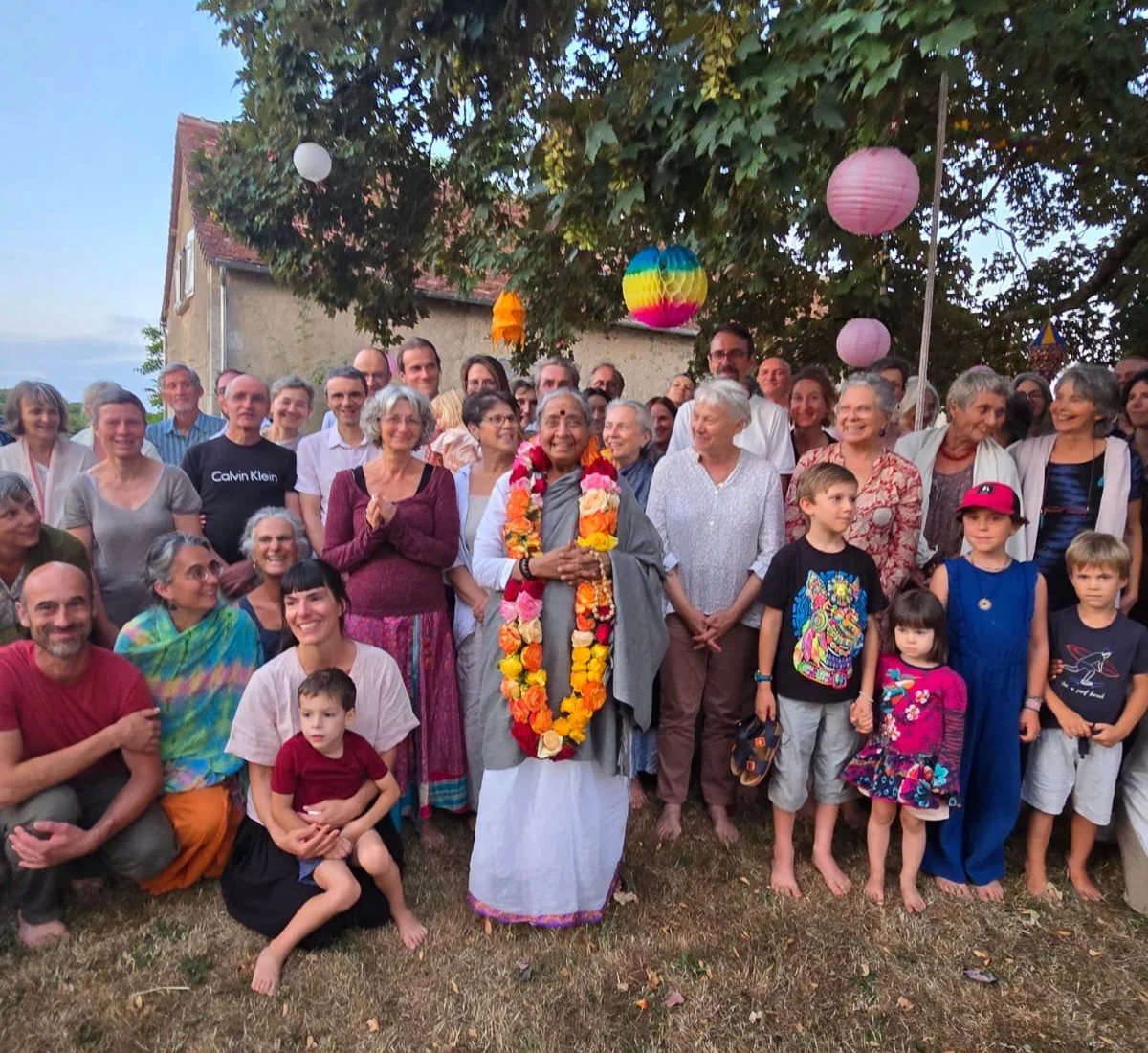
Ma Devaki at La Ferme de Jutreau in France.
Ma Devaki in Europe, August 2025
In the green-laden neighborhood of a quiet town on a winding road, in the compelling countryside of Germany, friends and devotees gathered at Anjaneya Ashram in Niederweiler to attend satsang with Ma Devaki, our spiritual elder who attended with devotion at the side of Yogi Ramsuratkumar during the last seven years of his life.
The folds of her garments told stories of her sacrifices—though she would say “blessings, not sacrifices.” On this hot day, Ma Devaki wore a heavy wool shawl draped over one shoulder, and the mala around her neck matched her silver and grey hair. Her face, always open and steady, was slightly lowered as she entered the room, where a crowd of people nestled closely together alongside the students of the ashram founder, Purna Steinitz, who had made the trip from Montana to be there.
Ma Devaki spoke of Yogi Ramsuratkumar, how the use of his name was the purpose of our lives, to remember God. We soaked up her words as she said, “If you aren’t chanting God’s name, you are carrying your own dead body around.” At times in her storytelling, she spoke her own name as if it were Yogi Ramsuratkumar speaking it— “Devki…”—and all the years of her time with him came alive in that moment.
Her stories fed the hungry crowd, and between satsangs the Indian devotees traveling with Ma Devaki sparkled and chanted in the kitchen as they helped to clean up after every meal. “Of course, it is the least we can do since everyone has worked so hard to make this happen,” one woman said smiling, her deep brown eyes contrasting with her festive yellow patterned punjabi.
New people joined the group every day and space was made for the children and adults to squeeze into the hot room, all eager to see and feel the presence of someone who lived such a life of service and devotion. Her countenance alone spoke volumes. Humility, spiritual intelligence, and clarity emanated from her.
From my view, the name of Yogi Ramsuratkumar had settled into her bones long ago; her very cells knew his name by heart. I had the sense that she repeated it even as she walked toward her seat to speak. Throughout our time together she would say, regarding the practice of chanting nama, “quantity, then quality.”
My husband and I returned home a little over a month ago from our trip. Saturated in the nama of Yogi Ramsuratkumar, it seemed that the “quantity” had allowed time for an alchemy to awaken. My hand was on the doorknob, and my husband said, “Yogi Ramsuratkumar,” and the door opened. We chanted together. There’s nothing like support from those around you. “Chanting together multiplies the power,” Ma Devaki emphasized. The substance of the name became a doorway to problem-free living. The ability to drop into this condition and drop out of the mass stress was like water to my parched throat.
Now I’ve been back home for a while, and my mind is back in full swing with responsibilities and distractions. It was easier to say the name of Yogi Ramsuratkumar in the company of Ma Devaki and while on the road. “Just start,” I hear her say. “No nama is wasted.” I find that the Way is both near and far.
“Chant out loud or silently. When silent, first the name is on your lips, then the lips fall still, and the tip of the tongue speaks his name, then the tip of the tongue quiets and the name is repeated in the throat, and then the heart. After that,” she gave a small flip of the wrist, a tilt of the head, and a look indicating “you’re being cooked” in the alchemical fire.
Spiritual giants know their purpose, the reason for their existence. Ma Devaki knew her purpose decades ago and has not wavered. Imagine seeing and meeting your own spiritual giant and knowing you wanted to spend the rest of your life serving him or her. Giving up career, family, personal preference, needing nothing about personal transformation, just wanting to serve this great being. Imagine knowing that is all you want, forever.
When she first met Yogi Ramsuratkumar, he couldn’t rid himself of her. “I was like a bad penny,” she said, smiling. Every weekend she came and hung around, wanting to do something for him. But he found others to do things in his world, to care for the simple human needs of a spiritual beggar.
Then, one day he asked her to empty his ashtray. She jumped up and complied. It was the only thing he had ever asked of her. She handled the ashtray with utter care. Going outside she approached the smelly, feces-infected gutter. She began to tip the ashtray, watching the cigarette butts of her master fall to the garbage below. Then, the entire ashtray slipped from her hands and fell into the putrid water!
She could not believe this! It was the only thing he had ever asked of her. She plunged her hand into the stink and retrieved the ashtray, frantically wiping it on her sari, cleaning it the best she could. Now she smelled too. There was no hiding what had happened.
She returned and told Yogi Ramsuratkumar the truth in front of all the men who were sitting there, who could judge her. He shook his head and said a few words of disappointment. Still, she came back the next day, and the next, like a “bad penny.”
Today, walking humbly into the room, nodding gently, she smiles at each person. As she makes her way to her chair it is as though Yogi Ramsuratkumar holds her up, moves her through the crowd, He sits her down, moves her mouth. She is not a lifeless puppet, she is warm, funny and personable, yet her spiritual master is there. He moves her now.
“Everything comes from Source, from God. We are not the Creator; we are the puppets. When you look closely you can see the strings moving a puppet,” she smiled. “That is how God is. He is doing everything. We just cannot see the strings.”
Her presence reflects the world she abides within. All is God. All is Father. She lives and breathes this deep and highest truth of India. The air, the Ganga, the mountains, all holy, all flowing with a substance that knows its Creator, knows the history of devotion, of sadhana. The Mahatmas—the Great Ones—can provide the teaching lessons. In Yogi Ramsuratkumar’s company, Ma Devaki heard stories of obedience, tapas, and transcendence that inspired her to accomplish the big sacrifices. She decided one day to stay up all night chanting nama. She wanted to please her master.
And so, she prepared and made the time. She began the daunting task of staying awake all night, eating the hot pickle chutney to stay awake and speaking the nama moment to moment. To keep herself awake she walked and chanted as tears ran down her face from the heat of the hot pickle. Morning came; she had done it! She could now tell her master about her accomplishment. With great excitement, she told him that she had chanted the name of God all night.
He looked at her…the very look that was often followed by the shake of his head…and he flipped his wrist, a gesture that could mean so many things. But on this day he was clearly dismissive, as if to say, “No Devaki, you think you did this. Father in Heaven, Father did this, Devaki.” He shook his head and flipped his wrist, and she learned the most profound lesson.
At one point during satsang, she began to speak of murder and murderers as a fact of karma. Even murder, war and great suffering is all “Father in Heaven.” Some of us began to fidget in our seats. Her matter-of-fact manner unsettled me. We, as westerners, are taught the difference between good and bad, right and wrong. Our black and white world of duality does not have room for the paradoxical, nondual nature of reality—the certainty of an ultimate Oneness, that “all is Father.” The idea the Divine is ultimately the murderer enacting a karma must be played out challenges the Western mind.
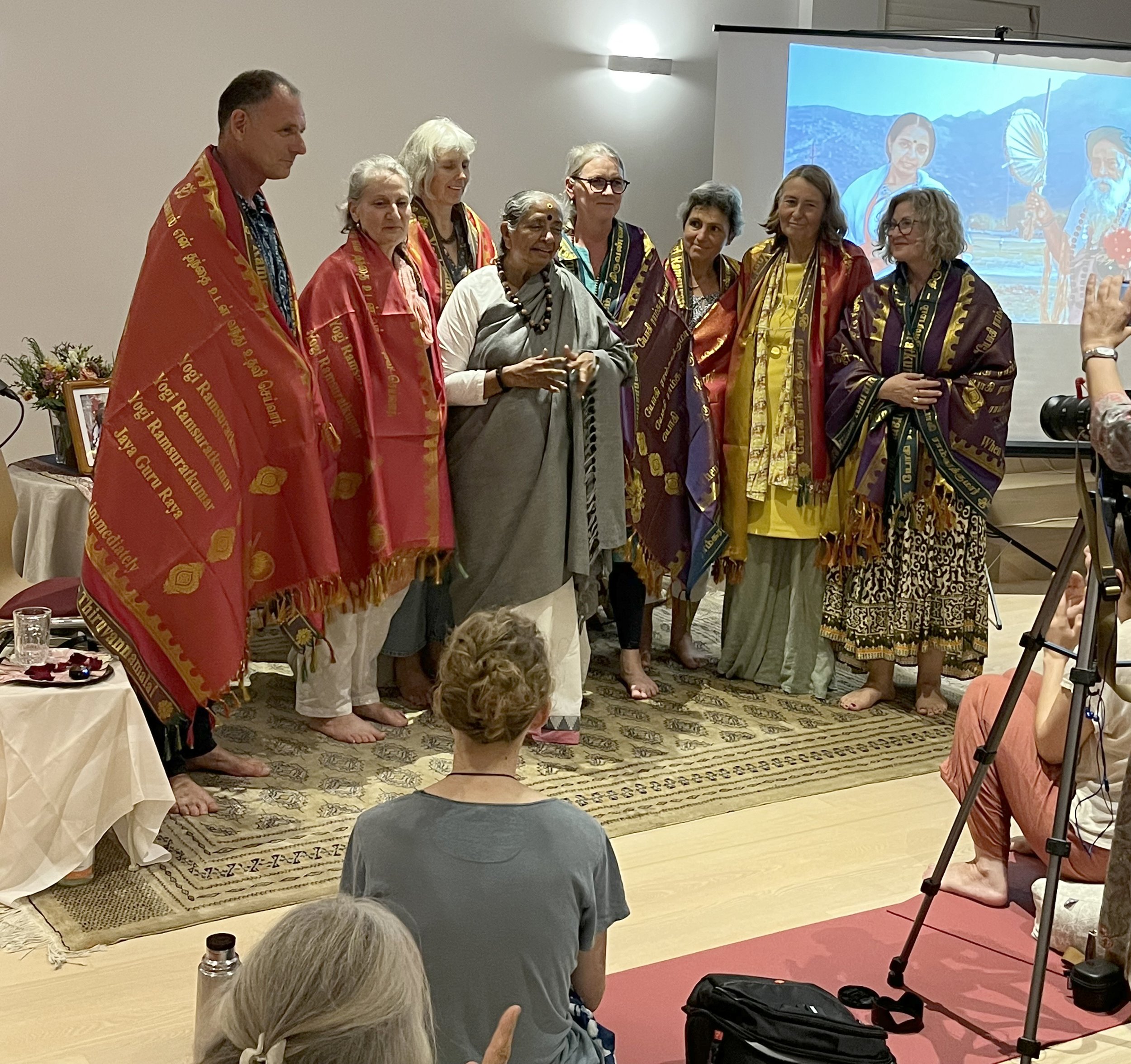
Ma Devaki with the sangha in Freibrg, Germany.
I remembered the day when I first moved to Prescott in the late 1980s. We were having a Saturday morning study group on the book, Vallabhacharya’s Commentaries on the Love Games of Krishna. Suddenly, Krishna was in front of me in all His Beauty, as tall as the ceiling. The colors of the sky were soft and perfect, the hills and streams, peaceful and exquisite. The vision was a still picture, not personal. Everything was vivid, the detail spectacular. Totally beautiful. I understood in that moment that the bad things of the world are also in that vision of the Divine. A bead or a bell on His Body could be the murderer; the shade of green could be some other suffering. All was represented in that detailed world of Krisna. This paradox moves me so much.
As I’ve traveled through Germany, Lisbon, Portugal, San Francisco, and over the Pacific Ocean back to home, I have chanted the nama of Yogi Ramsuratkumar more in the last few weeks than in my entire life. Despite good intentions, my mind, in the past, had not been inundated with Yogi Ramsuratkumar’s name. Perhaps that is why I was drawn to see Ma Devaki as she visited the German Sangha last month. The infusion of purpose and strength of her relationship with this practice, as a cosmic science, has taken me into the divine name—brought the divine name into me—more than ever before.
“Like the hairs on your head, your breath, your body—did you have your body? Do you make yourself breathe? Just because you don’t know how it all happens doesn’t mean it is not happening. Our bodies alone give proof to the wonder of what God can do.” She continued, “Our opinions and beliefs don’t change what’s true.”
“Take it or leave it,” she said. She offered only an invitation for experimentation. I must have heard a challenge in there, too, perhaps, like “prove me wrong.” In my delight, a little goes a long way. A gentle yet decisive dissolution of the problem mindset is happening as well as so much I don’t even see.
Ma Devaki spoke with the calm knowledge of Vedic truth, given by the seers of ancient India. She lived with the guru of gurus, the Beggar King, Yogi Ramsuratkumar. I wondered: who am I to question the possibility of this ancient practice? When problems arise, I take them as a reminder to chant. When my husband sees the “problem mindset” in either of us arising, he says the nama and we’re off on a chant. It’s a buddy system.
“It helps the body, changes it,” Ma Devaki tells us. It is alchemy, after all. All manner of possibilities lay on the tip of our tongue. Yet, when you chant, she reminded us, “Leave the results to God.”
Our ashrams, founded so long ago by Lee, reflect this clarity. We may focus on other aspects of the Path at times, but this ancient truth about the name of God has always been there. I believe every practice my teacher Lee gave us leads us to this truth, not as a mere mental idea but in an organic way, in our bodies, beyond mind.
The weekend intensive in Germany included a special public evening with Ma Devaki in a beautiful room in Freiburg. Her sari and shawl carried the ancient world of India. She was a reminder of purpose, and her words were simple, kind and straightforward. Chant the Name of God. Fifty people heard her message.
As she concluded her trip, she spent time individually with Lee’s sangha and the sangha of Anjaneya Ashram, who had worked together to host her and the group that traveled with her. To Lee’s students she said, “Chant with dedication for Mr. Lee’s Work. Dedicate your day, your chanting to Lee’s Work, to Yogi Ramsuratkumar. We cannot be chanting all the time, so dedicate whatever you are doing to God. Chant the Name seven times or chant for ten minutes as you dedicate your future day to God. And at the end of the day, offer your day to God.”
In this private session with Lee’s students, her communication was even more direct. She pointed out we were more dedicated to our opinions than to God.
“When you are sitting on your opinions, where is your interest in God?” She wasn’t asking for an answer; she was inviting us to take this question home with us and use it to change our lives.
“Mr. Lee said in his poetry to chant and speak the name of Yogi Ramsuratkumar,” she reminded us quietly. While she was thinking of Lee’s poetry, she added, “And read the poetry together and discuss it. Take time to discuss it. Lee’s poetry is very important.”
She brought up the importance of using the internet to communicate Lee’s teachings. It was a moment when her views collided with those of our teacher, Lee, who was adamantly not in favor of internet technology! A silent resistance came over the room. When it was explained to her, she said, “It seems old fashioned not to use the internet.”
I laughed to myself. This was not the first time Lee had been called “old fashioned,” even by himself! In fact, the use of internet technology to communicate about the spiritual Path and the guru lineage of this way is increasing. As the legacy of our teacher Lee sits in each of his students and friends uniquely, so too do his ashrams—the various places on the planet where Lee lived and taught—have their own expression. Everything is evolving, everyone doing the best they can.
“It is for the children,” she asserted. “The children need the Teaching. If it disappears, truth is gone from this world.” Her sense of urgency and need was evident. “Do things in your community for the children,” she begged.
This was our last meeting with Ma Devaki on this visit. She had visited many people and places in her travels in Europe, and now her purpose to spread the practice of chanting nama beckoned her onward. As she made her way into the van, we stood on either side of the steps chanting, the name of Yogi Ramsuratkumar on our lips.
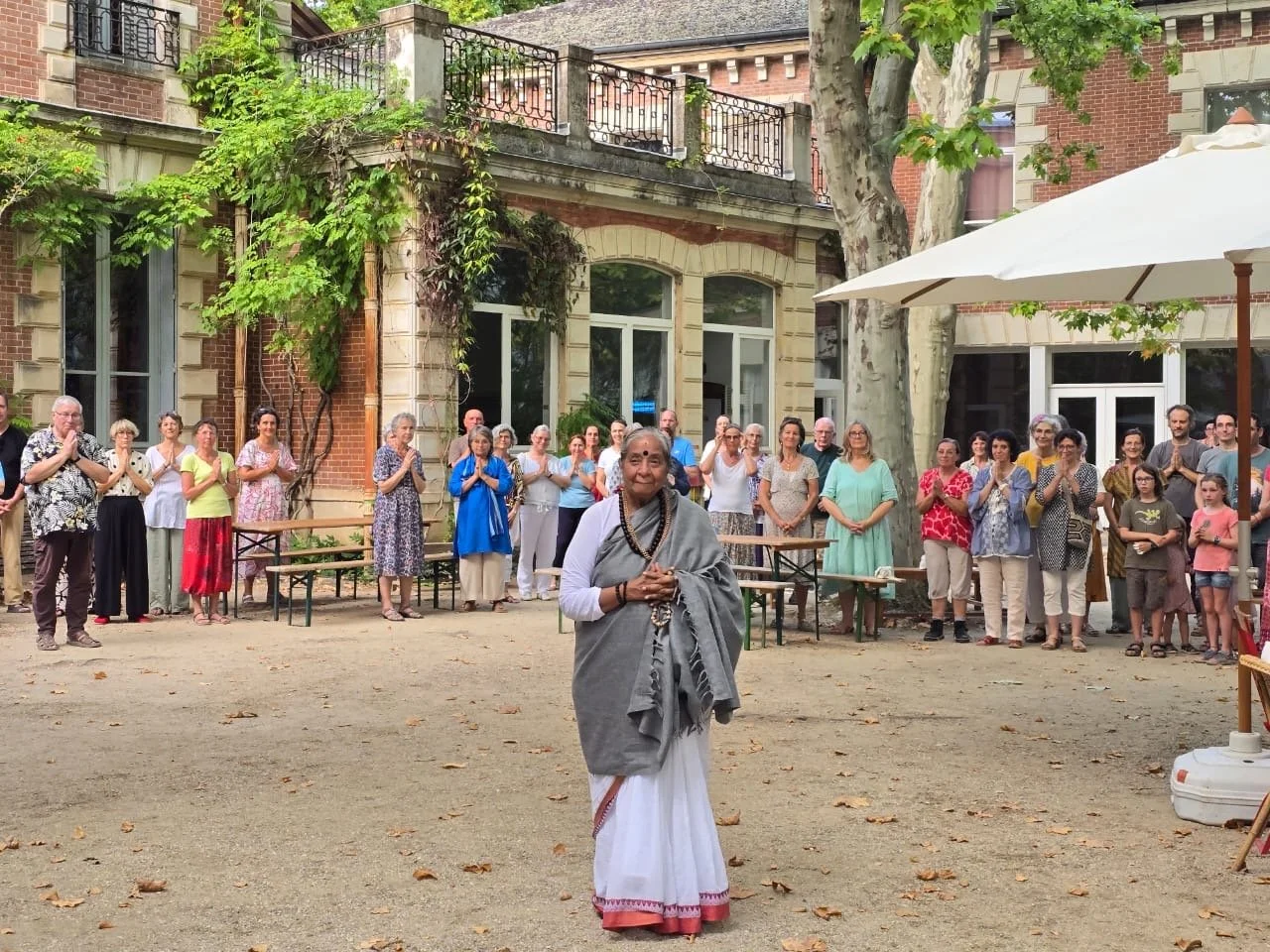
Ma Devaki at Hauteville in France.